


If you want to close sales and build customer loyalty, CRM (Customer Relationship Management) software is a must. Such a platform not only enables you to centralize customer data, but also to efficiently structure marketing, sales and technical support processes.
In your search for the ideal tool, you may well be looking at two solutions in particular: HubSpot and Salesforce. To help you make the right choice, we help you define which is best for your business. To do so, we compare their differences and features in a HubSpot vs Salesforce duel.
- 01 HubSpot vs Salesforce: overview
- 02 What's the difference between HubSpot and Salesforce?
- 03 HubSpot pros and cons
- 04 Salesforce pros and cons
- 05 HubSpot compared to Salesforce
- 06 Salesforce compared to HubSpot
- 07 Features comparison
- 08 HubSpot vs Salesforce: Which is the best for your business?
- 09 Alternatives to HubSpot & Salesforce
- 10 Promotions on CRM software
Start saving on the best SaaS
Secret has already helped tens of thousands of startups save millions on the best SaaS like Microsoft Teams, Google Workspace & many more. Join Secret now to buy software the smart way.

01 HubSpot vs Salesforce: overview
HubSpot and Salesforce are two leading customer relationship management (CRM) platforms, each renowned for its unique features and capabilities in empowering businesses to manage customer interactions and streamline sales processes.
HubSpot, known for its user-friendly interface and comprehensive inbound marketing tools, offers a wide array of functionalities, including CRM, email marketing, lead nurturing, social media management, and more. On the other hand, Salesforce is highly regarded for its robust CRM capabilities and extensive customization options, catering to the needs of enterprises and large organizations.
Now, let's dive into the comparison of HubSpot vs Salesforce. We'll explore their key features, pricing plans, integrations, and industry-specific functionalities to assist you in making an informed decision when choosing the ideal CRM solution for your business.

Sales pipeline management
Both SaaS solutions integrate sales pipeline tracking, but Salesforce’s rendering enables information to be visualized more quickly.

HubSpot
Salesforce
Sales forecasting
HubSpot lets you estimate future revenues and monitor their variations. Salesforce goes one step further with Einstein, which provides advanced AI-based forecasting.
HubSpot
Salesforce
Integrations
HubSpot connects to over 1,400 applications, including Mailchimp and Intercom. Salesforce AppExchange provides access to nearly 5,000 apps including Adobe or Zoom.
HubSpot
Salesforce
Contact and prospect management
HubSpot’s solution offers numerous features for managing leads and automating workflows. Salesforce asks to integrate the Pardot tools for lead management.
HubSpot
Salesforce
Reporting and analytics
An all-in-one tool, Hubspot is ideal for analyzing the entire customer experience. Salesforce, meanwhile, offers analyses based on the Einstein Analytics AI platform.
HubSpot
Salesforce
Communication and collaboration
The platforms integrate functionalities for communicating with customers or between agents via live chat, file sharing, chatbots or task tracking.
HubSpot
Salesforce
Customer support
In both cases, you need to opt for premium plans to benefit from multi-channel customer support (telephone, e-mail, chat).
HubSpot
Salesforce
Ease of use
HubSpot’s user-friendly interface makes it easy for newcomers to get to grips with the platform. Salesforce’s richness and complexity make it harder to grasp.
HubSpot
Salesforce
Positive reviews
Salesforce has almost 5 times as many reviews, even though it is rated lower for ease of use and value for money.
HubSpot
Salesforce
Pricing plans
Salesforce CRM price plans are on average more expensive than HubSpot. HubSpot also offers a free plan.
HubSpot
Salesforce
02 What's the difference between HubSpot and Salesforce?
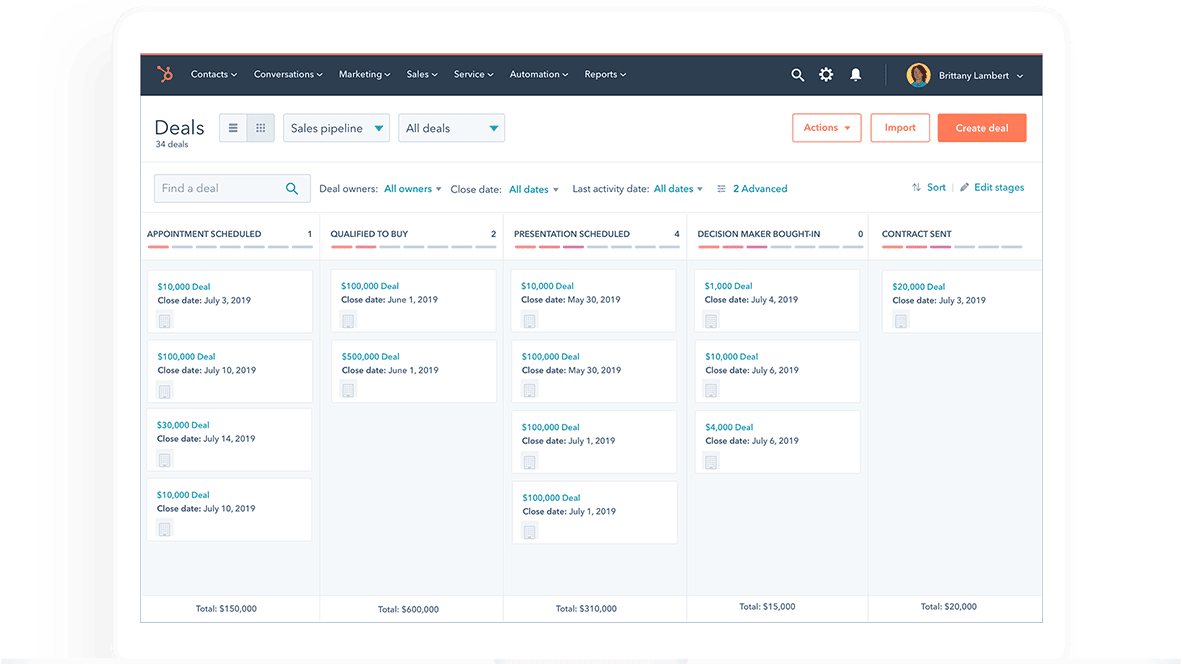
HubSpot's Deals and Tasks Stages Pipeline View
HubSpot
CRM, marketing automation & customer service software suite
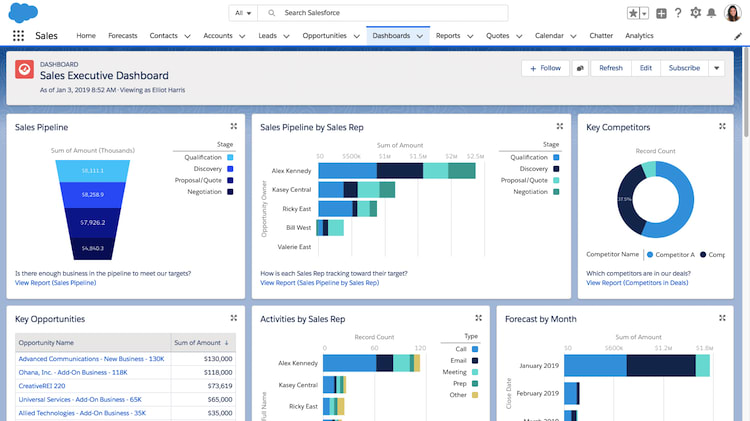
Salesforce Dashboard Sales Management
Salesforce
Salesforce is a widely-used cloud-based CRM platform that helps businesses organize customer data, manage sales and marketing workflows, and provide consistent support across different channels.
Both HubSpot and Salesforce are highly relevant SaaS solutions if you’re looking for reliable, reputable and comprehensive CRM software. However, their biggest difference lies in their target market. HubSpot is a more attractive choice for startups and SMEs. Salesforce, on the other hand, is an ideal choice for large enterprises. This difference in focus is the source of many of the differences we see when we compare these two software tools.
HubSpot is an all-in-one suite with integrated CRM functionalities. It's less expensive than its competitor Salesforce, but its functionalities mean it's primarily intended for use in marketing and sales. It's perfect for smaller companies or start-ups that don't necessarily have a great deal of experience in CRM deployment and operation. It's also easier to use and customize to your specific business needs. HubSpot's ease-of-use and attractive interface are major advantages. What's more, by centralizing sales, marketing, customer service and CRM in a single tool, HubSpot is a relevant choice for reducing costs.
Salesforce, on the other hand, is the CRM of choice for larger companies. More expensive, it is also a more complete CRM. With a steeper learning curve than HubSpot, the SaaS Salesforce solution sometimes requires initial training for employees to take full advantage of its functionalities. In fact, it offers a substantial number of functions and a very large number of software integrations. What's more, with Salesforce Einstein, it's possible to design predictive models, offer personalized recommendations to customers or even set up an AI-based chatbot.

HubSpot
Used by 2767 members
90% off the Professional and Enterprise plans for 1 year
Save up to $7,000

Salesforce
Used by 262 members
45% off the Starter Suite plan for 1 year
Save up to $675
03 HubSpot pros and cons
What are the advantages of HubSpot?
- Comprehensive marketing tools: HubSpot offers a wide range of marketing tools, including email marketing, social media management, content creation, and SEO optimization, allowing businesses to execute their marketing strategies effectively.

- Integrated CRM: HubSpot's built-in CRM enables seamless tracking and management of customer interactions, providing a centralized view of leads, deals, and customer data, facilitating better customer relationship management.
- Automation capabilities: The platform offers powerful automation features, enabling businesses to automate repetitive tasks, nurture leads, and personalize customer interactions, saving time and increasing efficiency.
- Extensive analytics: HubSpot provides detailed analytics and reporting, allowing businesses to measure the performance of their marketing efforts and make data-driven decisions to optimize campaigns.
- HubSpot Academy: HubSpot offers a wealth of educational resources through its HubSpot Academy, providing users with valuable training and certifications to enhance their marketing and sales skills.
What are the disadvantages of HubSpot?
- Cost: HubSpot's pricing can be relatively high, especially for smaller businesses or startups with limited budgets, making it less accessible for some organizations.

- Learning curve: While HubSpot offers robust features, mastering its platform may require time and effort, particularly for users new to marketing automation and CRM systems.
- Limited customization: While HubSpot provides some customization options, it may not be as flexible as other marketing automation tools, limiting certain advanced customization needs.
- Feature overlap: HubSpot's all-in-one approach may lead to feature overlap for users who only require specific tools, potentially paying for features they don't fully utilize.
- Support for multilingual websites: HubSpot's multilingual support may not be as extensive as some competitors, making it challenging for businesses with a global customer base.
Compare HubSpot to other tools


Monday vs HubSpot

Semrush vs HubSpot

Apollo.io vs HubSpot

Freshworks vs HubSpot

HubSpot vs WordPress.com

EngageBay vs HubSpot
04 Salesforce pros and cons
What are the advantages of Salesforce?
- Comprehensive CRM: Salesforce is renowned for its robust customer relationship management (CRM) capabilities, providing businesses with a centralized platform to manage leads, contacts, opportunities, and customer interactions.
- Scalability: Salesforce is highly scalable, making it suitable for businesses of all sizes. It can accommodate the needs of small startups as well as large enterprises with complex sales processes.
- Extensive integrations: Salesforce offers a wide range of integrations with other business tools and applications, allowing seamless data flow and enhancing overall business efficiency.
- Customization: Salesforce provides extensive customization options, enabling businesses to tailor the CRM system to meet their specific workflows and business requirements.
- Analytics and reporting: Salesforce offers advanced analytics and reporting features, providing businesses with valuable insights into their sales and marketing performance, enabling data-driven decision-making.
What are the disadvantages of Salesforce?
- Cost: Salesforce can be expensive, particularly for small businesses or startups, making it less accessible to those with limited budgets.
- Complexity: The platform's extensive features and customization options may lead to a steeper learning curve for new users, requiring proper training and onboarding.
- Setup and implementation time: Implementing Salesforce and customizing it to match specific business needs may take time and effort, delaying the realization of its full benefits.
- User interface: Some users find Salesforce's user interface to be complex and overwhelming, especially for those who are not familiar with CRM systems.
- Support and training costs: While Salesforce provides extensive resources for training and support, additional costs may be incurred for advanced training or premium support services.
Compare Salesforce to other tools


Freshsales Suite vs Salesforce

Zoho vs Salesforce

Zendesk vs Salesforce
Freshworks vs Salesforce

Pipedrive vs Salesforce
05 HubSpot compared to Salesforce
HubSpot and Salesforce are two powerful platforms in customer relationship management (CRM) and sales automation. Each platform offers unique strengths that cater to different user preferences.
HubSpot's strength lies in its simplicity and user-friendly approach, making it easier for teams to get started and achieve quick results. Salesforce, with its focus on customization and scalability, is well-suited for larger enterprises and businesses with complex sales processes, providing the flexibility to build tailored solutions.
Ultimately, the choice between HubSpot and Salesforce will depend on the specific requirements and objectives of each business. While HubSpot is ideal for those seeking simplicity and a comprehensive, all-in-one solution, Salesforce excels in its ability to adapt to unique business needs and provide advanced customization options.
Is HubSpot better than Salesforce?
 Is HubSpot better than Salesforce?
Making a choice between HubSpot and Salesforce depends on your specific business needs and requirements.
As industry-leading SaaS solutions, both platforms offer robust features and extensive integrations. However, HubSpot stands out with its user-friendly approach and built-in marketing automation capabilities. Its intuitive interface and drag-and-drop editors make it a top choice for users who are new to CRM or have limited technical expertise. In contrast, Salesforce's strength lies in its extensive customization options, making it an ideal fit for larger organizations with complex workflows and unique business processes.
What is HubSpot best used for?
HubSpot is best used for businesses aiming to create a seamless and integrated customer experience by bringing together marketing, sales, and service software into one platform.
As a leading inbound marketing solution, HubSpot offers a suite of powerful tools for SEO, blogging, social media, email automation, and analytics. Its CRM (Customer Relationship Management) system is free and acts as a central hub to organize, track, and nurture leads and customers.
This comprehensive approach enables businesses to attract, engage, and delight customers throughout their entire journey, making it a valuable asset for organizations seeking to optimize their marketing, sales, and customer service processes.
Can HubSpot replace Salesforce?
HubSpot can potentially replace Salesforce, especially for small to medium-sized businesses looking for a more user-friendly and all-in-one platform.
While Salesforce offers advanced customization and extensive features, HubSpot's simpler design and built-in capabilities may make it a suitable replacement for businesses seeking to streamline processes and increase efficiency. HubSpot's seamless integration of marketing, sales, and service tools in a single platform can be appealing for organizations that prefer a more straightforward and integrated approach to managing customer relationships and improving their overall customer experience.
However, for larger enterprises with complex needs, Salesforce's deep customization options and scalability might still be the preferred choice.
Is HubSpot cheaper than Salesforce?
HubSpot generally offers more cost-effective options compared to Salesforce, especially for small and medium-sized businesses.
HubSpot provides a range of free tools for marketing, sales, customer service, and content management system (CMS), making it an attractive option for businesses that want to manage customer relationships without incurring additional costs. HubSpot's free tools allow businesses to get started with essential features at no cost.
In contrast, Salesforce is known for its robust CRM capabilities and is widely used by large enterprises and sales teams. While Salesforce offers various pricing plans, it tends to be more expensive than HubSpot, particularly for businesses that require advanced features and customizations.
Both HubSpot and Salesforce have different strengths and cater to different types of businesses. Larger enterprises or those with more complex requirements may find the investment in Salesforce worth it due to its extensive customization and scalability options.
Is there a better CRM software than HubSpot?
Determining whether there is a better CRM software than HubSpot depends on the specific requirements of your business, like your specific CRM needs, budget and team size.
HubSpot is widely regarded as a top CRM solution due to its user-friendly interface, comprehensive features, and integration capabilities. However, there are other CRM options available, each with its own strengths and focus areas.
Salesforce, for example, is known for its scalability and customization options, making it a popular choice for larger enterprises with complex needs. On the other hand, Pipedrive is favored by many sales teams for its simplicity and focus on managing deals and sales pipelines. Other alternatives include ActiveCampaign, Mailchimp and Freshsales.
Discover how these tools could align with your requirements by taking of the free trials and demos provided so you can ensure that the CRM you choose has all of the essential features, from contact lists to customization, and integrations you need to manage your customer relationships effectively.

HubSpot
Premium
CRM, marketing automation & customer service software suite
90% off the Professional and Enterprise plans for 1 year
Save up to $7,000
06 Salesforce compared to HubSpot
Salesforce stands out with its extensive set of features and capabilities. It offers a highly customizable platform that can be tailored to meet the specific needs of businesses across various industries. Salesforce's strength lies in its scalability, making it suitable for small businesses as well as large enterprises. Its robust automation features and comprehensive reporting tools make it a preferred choice for organizations seeking advanced CRM functionalities.
HubSpot focuses on providing an all-in-one marketing, sales, and customer service platform. It emphasizes user-friendly tools and an intuitive interface, making it a popular choice for businesses looking for a straightforward approach to managing their customer relationships. HubSpot's integrated marketing automation and lead generation features make it a compelling option for startups and small to medium-sized businesses seeking a comprehensive CRM solution.
Businesses looking for extensive customization and scalability may find Salesforce more suitable, while those seeking a unified and user-friendly CRM experience may prefer HubSpot.
Is Salesforce better than HubSpot?
Determining whether Salesforce is better than HubSpot or vice versa depends on your specific business needs and priorities. Both platforms are well-regarded and offer powerful CRM capabilities, but they cater to different types of businesses and have distinct strengths.
Salesforce is known for its extensive customization options and scalability, making it an excellent choice for large enterprises with complex sales processes and data management needs. It offers a wide range of features and integrations, making it highly adaptable to various business requirements.
HubSpot, on the other hand, is designed to be user-friendly and easy to set up, making it a popular choice for small and medium-sized businesses (SMBs) that may not have extensive IT resources or technical expertise. It focuses on providing a straightforward CRM and marketing automation solution that can be quickly implemented and adopted by teams.
In summary, larger enterprises with complex sales processes and a need for extensive customization may find Salesforce to be a more suitable choice. On the other hand, smaller businesses or those seeking an easy-to-use and cost-effective CRM solution may find HubSpot to be a better fit.
What is Salesforce best used for?
Salesforce is a powerful Customer Relationship Management (CRM) platform that is best used for managing customer relationships and sales processes at a large scale. It provides businesses with tools to store and organize customer data, track sales leads and opportunities, automate marketing campaigns, and improve overall customer engagement.
Salesforce is widely used by sales teams, marketing departments, and customer service teams to collaborate, track customer interactions, and gain insights into customer behavior and preferences. Its advanced analytics and reporting capabilities allow businesses to make data-driven decisions and optimize their sales and marketing strategies.
With its customizable features and extensive range of integrations, Salesforce can be tailored to meet the specific needs of various industries and business sizes, making it a versatile and popular choice for enterprises across different sectors.
Can Salesforce replace HubSpot?
Salesforce can potentially replace HubSpot, but it largely depends on the specific needs and requirements of the company. Salesforce is a powerful and highly customizable CRM platform that is well-suited for large enterprises with complex sales processes and a need for extensive tracking and forecasting capabilities. It offers advanced features for data management, automation, and reporting, making it a comprehensive solution for managing customer relationships.
On the other hand, HubSpot is known for its ease of use and all-in-one marketing, sales, and service platform. It is popular among small to medium-sized businesses that prioritize simplicity and want a user-friendly solution for inbound marketing and customer relationship management.
If a company values flexibility and extensive customization, Salesforce might be a better fit. However, for smaller teams or businesses looking for an all-in-one marketing and sales solution, HubSpot may be the preferred choice due to its simplicity and ease of setup and use.
Is Salesforce cheaper than HubSpot?
Salesforce is generally considered to be more expensive than HubSpot. Both platforms offer different pricing tiers and plans, but Salesforce's overall cost tends to be higher due to its complexity and enterprise-level features.
Salesforce is known for its robust customization options and scalability, which can result in higher costs, especially for large enterprises with complex needs. Additionally, Salesforce often requires additional expenses for customizations, integrations, and implementation, which can significantly increase the total cost of ownership.
HubSpot, on the other hand, offers more straightforward pricing plans and includes many features in its base plans without additional costs. This makes it a more cost-effective option, particularly for small to medium-sized businesses that may not require the extensive capabilities and customization options provided by Salesforce.
Is there a better CRM software than Salesforce?
Determining the best CRM software depends on the specific needs and goals of a business. While Salesforce is a powerful and widely used CRM platform that excels in serving large enterprises with complex requirements, there are other CRM options that may be considered better for different types of businesses, especially smaller businesses or startups.
Other SaaS software that may be considered more user-friendly and cost-effective CRM solutions are HubSpot, Freshsales, Zendesk, LeadSquared and Zoho CRM to name a few.
It's essential to carefully assess each platform's strengths and weaknesses and conduct thorough research to find the CRM software that best aligns with your unique needs and workflows, from the needs of your sales team to marketing workflows to scalability.

Salesforce
Premium
The world’s #1 AI CRM
45% off the Starter Suite plan for 1 year
Save up to $675
07 Features comparison
Salesforce’s Mobile Application is More Accessible
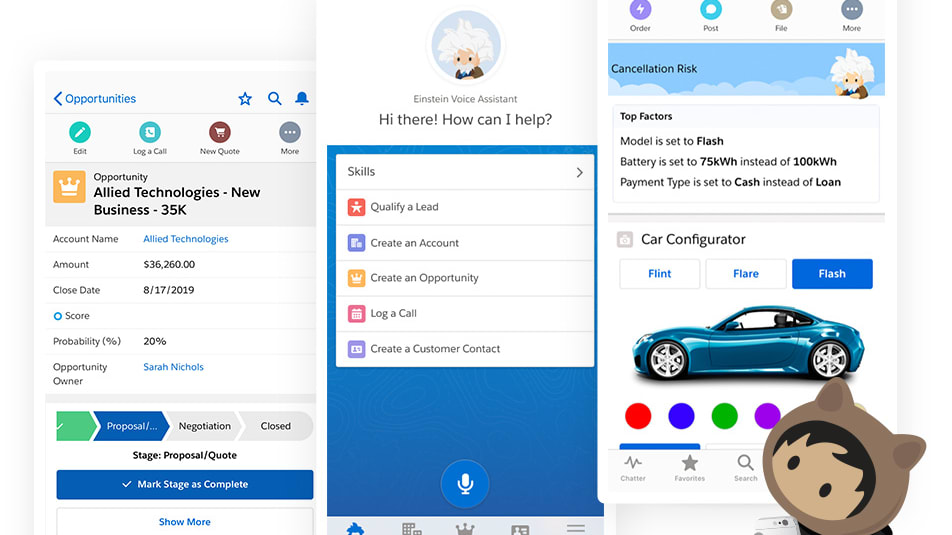
The Salesforce mobile app provides a seamless and comprehensive experience
Salesforce's mobile application is undoubtedly a valuable asset for entrepreneurs and professionals on the move. The Salesforce mobile app provides a seamless and comprehensive experience, allowing users to manage contacts, deals, tasks, and more directly from their smartphones or tablets. This accessibility offers increased flexibility and convenience, enabling users to stay connected and in control of their business processes even while on-the-go.
In contrast, HubSpot's mobile capabilities are more limited, and its mobile app primarily focuses on basic functionalities like email and basic CRM features. While HubSpot does have a mobile app, it doesn't provide the same level of comprehensive management that Salesforce's app offers.
In conclusion, Salesforce's mobile application provides entrepreneurs with a powerful tool to manage their business processes effectively while away from their desks, giving it an advantage in terms of accessibility and mobile productivity over HubSpot.
HubSpot Surpasses Salesforce in Email Tracking and Templating

Know when leads engage with your emails and turn them into deals faster with perfectly timed, personal follow-ups.
HubSpot excels in email tracking and templating, offering businesses powerful tools to enhance their email marketing efforts. With HubSpot's email tracking feature, users can gain valuable insights into their email campaigns' performance,receiving real-time notifications when recipients open, click, or engage with their emails.
In terms of email templating, HubSpot offers a wide array of professionally designed templates that can be customized to match a brand's style and message. The drag-and-drop editor makes it easy to create visually appealing and engaging emails without the need for technical expertise.
While Salesforce also offers email functionality, HubSpot's email tracking and templating features provide a more comprehensive and user-friendly experience for businesses that prioritize email marketing. HubSpot's focus on delivering personalized, trackable emails with detailed analytics and a variety of templates makes it a preferred choice for organizations.
The choice between HubSpot and Salesforce ultimately depends on the organization's specific needs and priorities. Businesses looking for robust email tracking and templating capabilities, combined with a user-friendly interface, may find HubSpot to be the better fit for their email marketing efforts.
Salesforce Pulls Ahead with its Integration Possibilities

Salesforce takes the lead when it comes to integration possibilities, thanks to its robust API and extensive ecosystem.
Salesforce takes the lead when it comes to integration possibilities, thanks to its robust API and extensive ecosystem. Its seamless integration with numerous third-party applications offers businesses more flexibility and tailored solutions to meet their specific needs. The Salesforce AppExchange, being a market leader, provides users with access to over 5,000 solutions that can be easily integrated into their CRM system, like Mailchimp, Slack and SurveyMonkey.
While HubSpot also supports various integrations, its ecosystem is comparatively smaller than that of Salesforce. For businesses that require extensive connectivity with a diverse range of platforms, Salesforce is likely the more suitable choice, providing a wider array of options for seamless integration with other tools and applications.
HubSpot is Better at Content Management than Salesforce
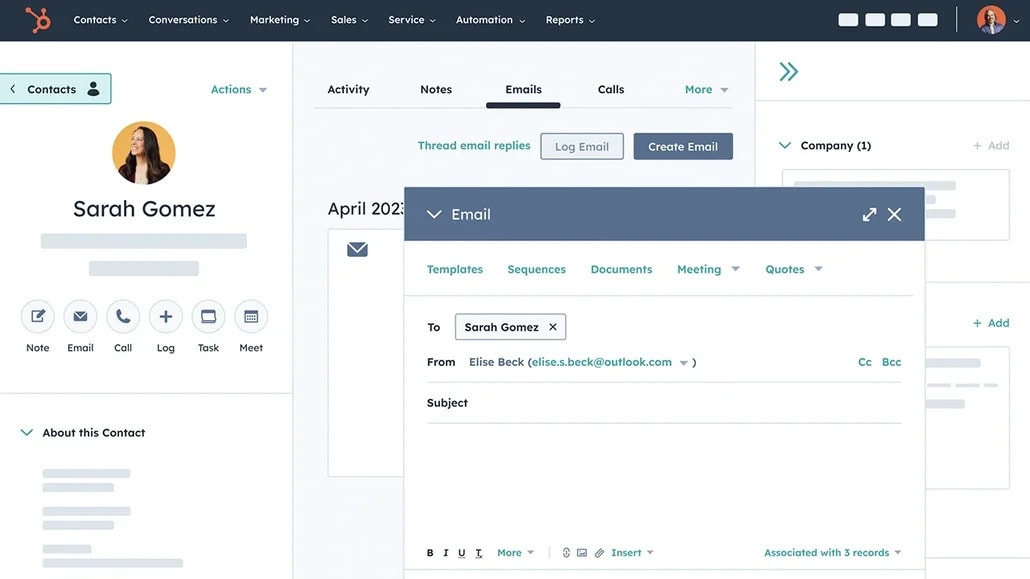
HubSpot's user-friendly drag-and-drop editor empowers businesses to build not only landing pages but entire websites effortlessly
When it comes to content management, HubSpot takes the lead over Salesforce with its robust set of features. HubSpot's user-friendly drag-and-drop editor empowers businesses to build not only landing pages but entire websites effortlessly, a capability that is absent in Salesforce. This intuitive editor allows marketers and content creators to craft engaging content that drives conversions without the need for coding or technical expertise.
Furthermore, HubSpot offers a comprehensive suite of content tools, including a blog editor, social media management, and email marketing features, all seamlessly integrated with its CRM. This cohesive approach enables businesses to create, distribute, and track content effectively, driving engagement and nurturing leads throughout the customer journey.
In contrast, while Salesforce is a powerful CRM platform, its content management capabilities are not as extensive as HubSpot's. Salesforce primarily focuses on customer relationship management and sales-related functions, lacking the content-specific tools offered by HubSpot.
HubSpot and Salesforce are Equally Proficient at Lead Management

Organize, prioritize, and engage prospects in one centralized platform with free lead management software.
HubSpot and Salesforce are undoubtedly among the best choices for businesses seeking efficient lead management solutions. Both platforms excel at providing a comprehensive set of features to track and manage leads, empowering sales teams to maximize their productivity and effectiveness.
HubSpot's lead management capabilities include lead tracking, automated lead assignment, and lead scoring based on engagement and behavior. Its intuitive interface and seamless integration with marketing tools enable businesses to nurture leads and convert them into customers more effectively.
Similarly, Salesforce offers a robust lead management system with advanced functionalities like lead assignment rules, lead conversion tracking, and customizable sales processes. Its flexible and customizable platform allows businesses to tailor their lead management workflows to suit their specific needs and sales processes.
In summary, both HubSpot and Salesforce offer powerful lead management capabilities, making them equally proficient choices for sales-driven businesses. The decision between the two ultimately depends on other factors, such as the overall business requirements, budget, and existing technology stack.
HubSpot Offers a More Robust Sales Pipeline Management than Salesforce

Visualize your entire sales cycle using pipeline management software to prioritize leads and close more deals.
HubSpot indeed offers a robust sales pipeline management system that stands out for its visual intuitiveness and organization. With HubSpot's sales pipeline, users can easily set up customized stages and milestones to represent the different steps in their sales process.
HubSpot's user-friendly drag-and-drop interface makes it easy to move deals along the pipeline, enabling sales teams to track the progress of each opportunity effortlessly. The visual representation of the pipeline provides a clear overview of the sales process, allowing users to identify bottlenecks, prioritize deals, and make data-driven decisions to improve sales efficiency.
While Salesforce also offers sales pipeline management capabilities, some users may find HubSpot's approach more user-friendly and visually appealing. Salesforce's sales pipeline management is highly customizable but may require more technical expertise to set up and maintain compared to HubSpot's more straightforward and visual approach.
In conclusion, HubSpot's sales pipeline management offers a compelling combination of visual intuitiveness, customization, and powerful analytics, making it an excellent choice for businesses seeking a user-friendly and robust sales management solution.
HubSpot Emerges as a Clear Winner for Ease of Use
HubSpot stands out as the clear winner when it comes to ease of use among CRM software options.
HubSpot stands out as the clear winner when it comes to ease of use among CRM software options. With a strong focus on user-friendly design, HubSpot provides an accessible platform for users of all levels of experience in the world of SaaS tools. Its intuitive interface and simple navigation make it easy to set up and start executing marketing strategies without requiring extensive technical knowledge.
On the other hand, Salesforce, while offering a plethora of features and functionalities, often comes with a steeper learning curve, making it less approachable for newcomers to CRM software. Its comprehensive capabilities may be overwhelming for users who are not well-versed in CRM tools.
For businesses valuing quick adaptability and a straightforward user experience, HubSpot provides an unmatched user-friendly environment to manage customer relationships and enhance marketing efforts.
08 HubSpot vs Salesforce: Which is the best for your business?
HubSpot is the best tool for you if:
- You're looking for SaaS software with a free plan that lets you try out the tool in practice without incurring any costs
- You prefer a platform with responsive customer service, available if your teams need help
- You want a solution that integrates a wide range of relevant functions to manage leads and automate workflows
- You'd like the tool to offer content management functions to design impactful landing pages for your marketing purposes
- You prefer CRM software that lets you build and track email campaigns that win over your target audience
 You're looking for SaaS software with a free plan that lets you try out the tool in practice without incurring any costs
Salesforce is the best tool for you if:
- You want to connect your CRM with all the software you currently use via numerous interactions
- You prefer an online tool that lets you view sales pipeline information without wasting time
- You're looking for software that integrates comprehensive, robust customer communication and collaboration functionalities
- You'd like the platform you select to offer advanced AI features, including predictive analytics
- You need a SaaS solution with a mobile version so that all employees can access information on the move
HubSpot
Used by 2767 members
90% off the Professional and Enterprise plans for 1 year
Save up to $7,000
Salesforce
Used by 262 members
45% off the Starter Suite plan for 1 year
Save up to $675
09 Alternatives to HubSpot & Salesforce

Brevo (ex. Sendinblue)
Used by 4651 members
75% off the annual Starter and Standard Plans
Save up to $5,661

Apollo.io
Used by 4370 members
50% off the annual Basic or Professional plan for 1 year (Up to 5 seats)
Save up to $3,000

Slack
Used by 3708 members
25% off new plan purchases
Save up to $9,000

Intercom
Used by 3201 members
1 year free on the Advanced plan (300 monthly Fin resolutions included)
Save up to $3,108
10 Promotions on CRM software
HubSpot and Salesforce are great tools, but Secret offers promo codes with discounts on over 2190+ different SaaS solutions. New deals are added regularly, helping you save money on your online subscriptions. Get access to codes for other CRM software you might want to purchase

Pipedrive coupon code
30% off for 12 months

Promo code Zoho
$3,000 in credits for 1 year

folk CRM promo
14 days free + 20% off annual plans

Notion offer
6 months free on the Business plan with Unlimited AI

Discount for Zendesk
6 months free (with AI Agents and Copilot)

HighLevel discount code
First month free

Promo code for Freshworks
14 days free on Freshdesk

Attio promotion
14 days free + additional 10% off monthly or annual plans

Clay deal
14 days free + 10% off annual plans

ActiveCampaign coupon
90% off any annual plan for the first year
Start saving on the best SaaS
Secret has already helped tens of thousands of startups save millions on the best SaaS like Microsoft Teams, Google Workspace & many more. Join Secret now to buy software the smart way.